Custom Conveyor Design, Fabrication and Assembly: What Do You Need to Prepare?
The information to send when ordering a conveyor design, how to choose the configuration, the fabrication and assembly process, and a checklist for trial runs and acceptance.
Designing a custom conveyor does not start with choosing a motor or buying a belt. The starting point is the product to be conveyed, the line's takt and the installation space. Only when this data is clear is there a basis for selecting the mechanical, drive and control solution.
This article helps purchasing, engineering and production teams prepare the documents for ordering a flat belt conveyor: from the input requirements to the points to check during assembly and acceptance.
What jobs is a flat belt conveyor suited to?
A flat belt provides a continuous support surface for moving products between workstations. This configuration can be considered for component transfer, inspection, assembly or packing, provided the product and the environment are suitable.
Not everything that needs to be conveyed suits the same belt. Parts with sharp edges, products that roll easily, hot items or static-sensitive components need to be assessed separately. Where precise positioning is required, the fact that a conveyor can move the product does not mean it meets the stopping accuracy at a station.
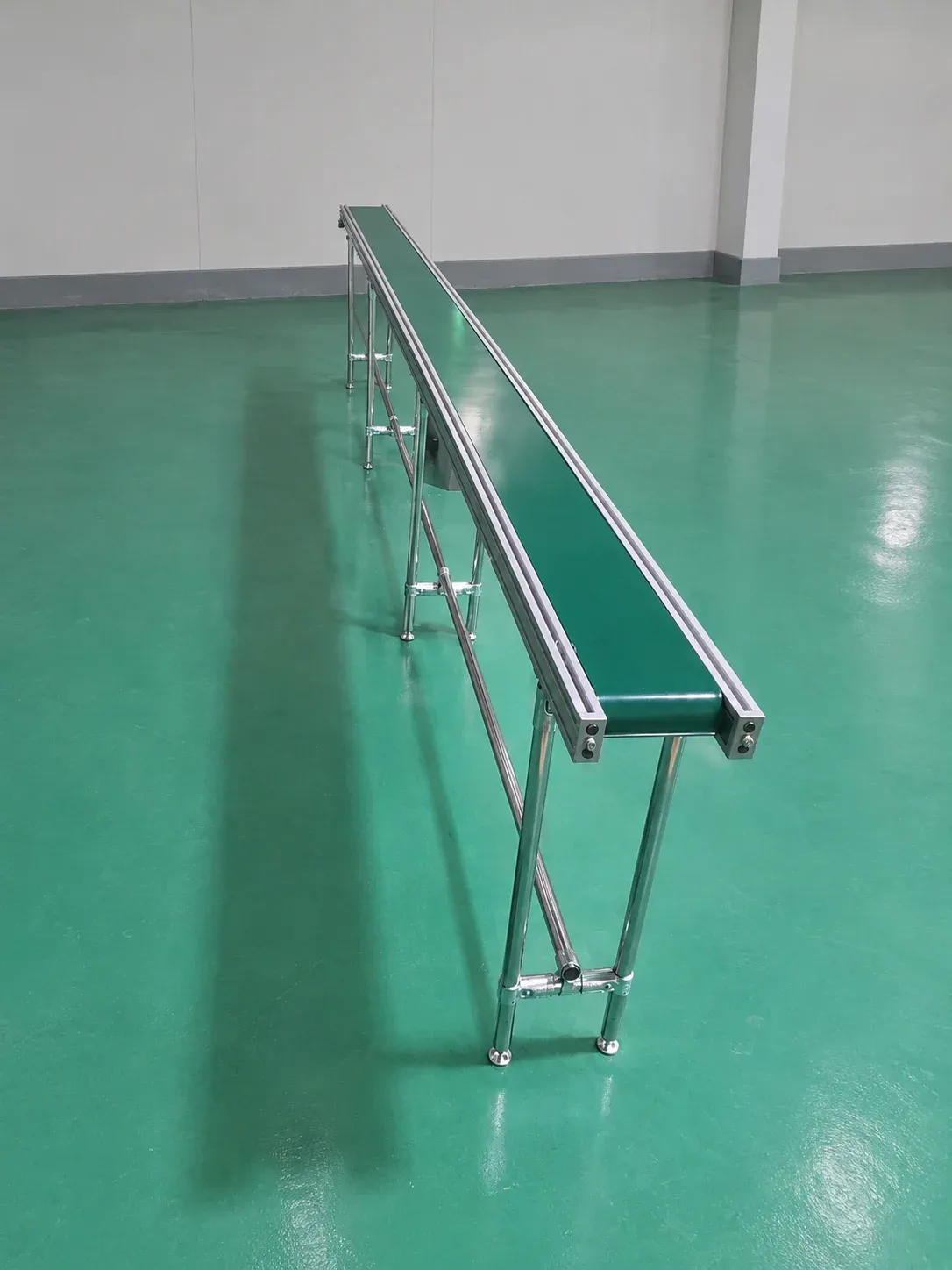
The photo provided by ZINITEK shows a straight belt conveyor configuration with a green belt, two side rails and tubular support legs. This is a description of what can be seen, not a substitute for a dimensioned drawing or the equipment's specification sheet.

Information to send before requesting a quote
Product and conveyed load
Provide the product's dimensions, weight, base shape and orientation. If several products are on the belt at the same time, describe how many and how they are distributed, not just the weight of a single item.
Product photos, drawings or physical samples help check the risk of slipping, tipping, catching in transfer gaps or rubbing against guide rails. If the product comes in several variants, provide the smallest, the largest and the heaviest.
Installation dimensions
The documents should show the conveying length, the usable belt width, the infeed and outfeed heights and the positions of the workstations. Distinguish between the belt width and the overall width of the machine.
The layout must leave space for the drive unit, the control cabinet or box, cleaning and belt replacement. Equipment that fits its footprint but has no maintenance access can still be difficult to use.
Production takt and operating mode
State the target output, the spacing between products, and whether the conveyor runs continuously or in indexed cycles. If it must stop at a station, add the dwell time and positioning requirements.
Belt speed should not be chosen independently of the upstream and downstream processes. A faster conveyor does not necessarily increase output if the next process cannot keep up.
Environment and electrical requirements
Describe dust, oil, humidity, temperature, cleaning method and the available power supply. If there are ESD, food contact or chemical exposure requirements, they must be stated at the survey stage so that suitable materials and configuration can be chosen.
You cannot conclude that a belt meets anti-static or food contact requirements just from its green color. These requirements need material documentation, supplier information and specific test criteria.
Choosing the mechanical configuration and drive
The frame and support legs need to be considered according to the load, conveyor length and mounting location. Connection points, leg spacing and stability must be checked on the actual design.
For the belt, agree on the material type, surface, splicing method and product contact conditions. When selecting pulleys, check them against the requirements of the belt being used. A single diameter or tension value should not be applied to every configuration.
The drive unit needs to be selected together with the working load, speed, starting mode and operating hours. Its location must satisfy both the installation space and maintenance access.
If speed adjustment or interlocking with other machines is needed, a compatible control solution must be defined. PLCs, sensors and inverters are not standard equipment on every conveyor by default.

The process from requirements to assembly
1. Survey and finalize requirements
Compile the product, layout, load, operating takt and electrical requirements. Agree on the scope of supply: mechanical parts only, complete equipment, or integration with an existing line.
2. Design and drawing approval
The layout drawing should show the overall dimensions, heights, conveying direction, drive position and mating interfaces. Changes affecting the layout should be resolved before fabrication.
3. Fabrication and assembly
Inspect the parts against the approved drawing, then assemble the frame, support legs, pulley assemblies, belt and drive. Alignment should follow the component instructions and the specific configuration.
4. Trial run and adjustment
Test without load first, then run with representative products and loads according to the test plan. Watch the belt tracking, edge rubbing, slipping, vibration, abnormal noise and transfer between stations.
5. Acceptance and handover
Compare the results against the agreed requirements. The handover documents should define how to operate and maintain the equipment, the list of replacement parts and the equipment's conditions of use.
Conveyor acceptance checklist
- Dimensions, heights and conveying direction match the approved drawing.
- Support legs are stable; joints and assembled parts have been checked.
- Products pass through the infeed, outfeed and stations without catching or falling under the agreed test conditions.
- The belt does not rub its edges or track abnormally during the test.
- Run, stop and interlock modes meet the contract scope.
- Entanglement and pinch points have been assessed; guarding and safety controls have been checked by a qualified person.
- Operating and maintenance instructions are provided to match the configuration handed over.
This checklist is a framework for technical discussion; it is not a safety certification and does not replace a risk assessment for a specific machine.
Why do quotes for the same length still differ?
Length is only one part of the configuration. Width, load, belt, frame, motor, controls and installation work all affect the scope of supply.
To compare quotes, ask every supplier to quote against the same set of requirements. Clearly separate mechanical parts, electrical controls, accessories, shipping, installation and trial runs. Do not compare a mechanical assembly without controls to equipment that already includes line integration.
See also the PLC and automation survey checklist when the conveyor has to work with sensors or other machines. For custom mechanical parts, see our CNC milling service.
Frequently asked questions
Can we discuss a solution without CAD drawings?
You can start with product photos, key dimensions, the floor layout and a description of the task. However, the solution and the quote need to be based on confirmed data; an approved drawing is an important basis before fabrication.
Can the load capacity be determined from a photo of the conveyor?
No. A photo helps identify the configuration but does not reveal the full materials, thicknesses, drive unit or test conditions. Load capacity must be determined through design and corresponding testing.
Does every conveyor need a PLC?
No. The control configuration depends on the operating mode and the level of interlocking. State clearly whether the conveyor runs standalone, needs speed adjustment, stops on a sensor signal or coordinates with other machines.
Send a conveyor design request
For ZINITEK to discuss the design, fabrication and assembly of your conveyor, send product photos, dimensions, load, operating takt and the installation layout via our contact page. If you already have CAD data, add the layout drawing and the interfaces to be connected so the technical scope can be checked.
References
MISUMI - conveyor configuration and component selection provides input categories for layout, drive position, dimensions, motor, weight and speed.
Dorner - 2200 iDrive conveyor is the manufacturer's configuration reference. The manufacturer's product specifications are not used as specifications for ZINITEK equipment.